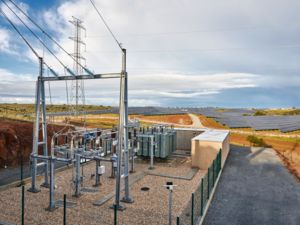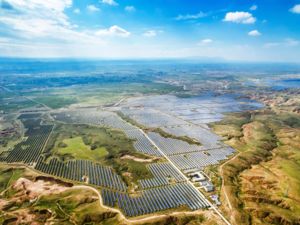
Solar power is essential for renewable power generation. It makes a major contribution to meeting our continually rising energy requirements. Networking, monitoring, and communication are indispensable in this regard, particularly in relation to consistent network quality and maintenance in line with requirements. Phoenix Contact is your expert partner for the optimal and reliable operation of photovoltaic systems. From ground-mounted systems and rooftop systems to hybrid energy systems, we always provide the right solution.
Solutions for solar park management
Operating large PV systems requires continuous monitoring and control on the segment level. Reliable monitoring solutions keep you informed of the state of your photovoltaic system at all times, allowing you to respond immediately to ensure maximum yield. Learn more about the solutions from Phoenix Contact that enable you to constantly collect, visualize, and evaluate data from your solar park.
Feed-in management
Connecting decentral power generation plants to the grid
The innovative solutions from Phoenix Contact help you to connect decentral power generation plants flexibly in accordance with the local requirements of the grid operator.
Acquisition of weather data
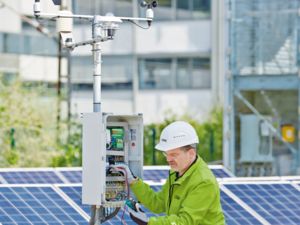
Weather stations for photovoltaic systems
Operators of photovoltaic systems want to be kept informed about the energy efficiency and reliability of their ground-mounted system at all times. One possible measurement of this is the performance ratio, which indicates the ratio of the actual system yield to the yield that is theoretically possible.
If the value decreases unexpectedly, this indicates a system error. Weather stations measure important weather data, such as solar irradiation, wind speed, and temperature, around the clock. These data are included in the calculation of the performance ratio.
Data loggers
Optimum networking
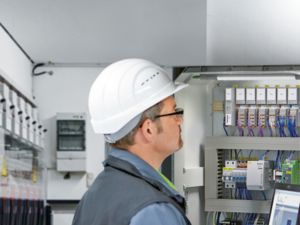
In order to operate large-scale photovoltaics systems efficiently, ongoing monitoring and control is required.
A solar system of a magnitude of 10 MW is composed of some 2,500 strings for every 20 solar panels. It consists of a variety of string combiner boxes, inverters, and additional monitoring components such as reference sensors, weather stations, or energy measuring devices.
A myriad of measurement data must be acquired and processed further, inverters must be controlled, and the system status must be transmitted to a higher-level data management system.
Your advantages:
✔ Low engineering and operating costs thanks to intelligent automation solutions
✔ Redundant – and therefore failsafe – networks
✔ Fewer errors during configuration with Auto Detection Mode
✔ Avoidance of data gaps with temporary data storage
String combiner for photovoltaic systems
Custom solution concepts
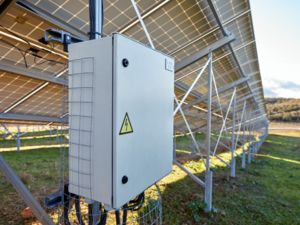
Specialists who design and build photovoltaic systems face the challenge of achieving maximum availability and performance of photovoltaic systems. The important factors here are collecting and distributing string currents, protecting the individual modules against damage from lightning and overvoltage, and monitoring the performance of the system.
String combiner boxes (SCBs) from Phoenix Contact meet these requirements in a space-saving housing. Our monitoring system for photovoltaic string currents allows you to respond immediately to malfunctions and power losses, even when individual strings fail.
Inverter communication
Easy implementation of photovoltaic projects
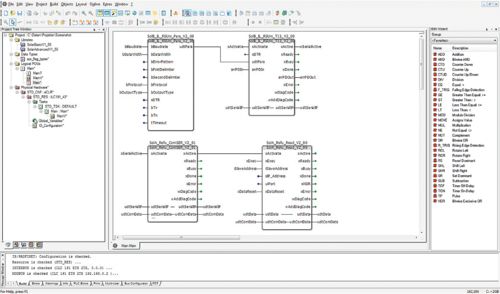
Photovoltaic projects can be easily implemented with our Solarworx software library in the PLCnext Engineer programming software from Phoenix Contact. It includes drivers for data loggers and interfaces for inverters, energy measuring devices, and portals. It also includes complex blocks for solar altitude calculations and monitoring photovoltaic trackers, for example. To keep the engineering outlay for commissioning photovoltaic systems to a minimum, we are constantly developing new drivers and function blocks for the integration of further inverters.
Solar tracking
Small-scale controllers with an integrated Modbus interface are ideal for controlling tracking systems.
Step motor drivers and frequency converters can be connected directly without any additional modules. Analog or incremental input channels are available for position detection.
The hybrid motor starter offers four functions for tracking the photovoltaic panels: forward running, reverse running, motor protection, and emergency stop.
In comparison to mechanical contactors, the motor starter is significantly more durable, saves space, and can be wired quickly.
Phoenix Contact provides a comprehensive library with complete function blocks. This includes, among other features, complex blocks with DIN/NREL algorithms for solar altitude calculation and for monitoring the photovoltaic trackers.
It ensures that the photovoltaic panels are always aligned perfectly with the sun at any time of the day or year and provide maximum yield.
Connection technology for PV ground-mounted systems
Safe connection
From the photovoltaic panel and the string combiner box to the inverter: Phoenix Contact provides numerous cabling solutions that are perfectly tailored to the requirements of ground-mounted photovoltaic systems.
These were designed with durability and quick and easy installation in mind. The DC connectors that can be assembled in the field can be mounted in just a few seconds without special tools. The tailored, high-quality components contribute to a sustainable, high system availability, even under extreme weather conditions.
Your advantages:
✓ Easy mounting with tool-free fast connection technology
✓ High degree of protection against impermissible cross connections thanks to the unique pin connector pattern
✓ UV, temperature, and weather-resistant design
✓ High degree of flexibility with the comprehensive product portfolio for cable cross sections from 2.5 mm² to 16 mm²
Video surveillance in the solar industry
Safe and secure – during the day and night
As the installed capacity of solar power grows, so too does the number of incidents at systems. Criminals are not just focusing on solar panels, but are also increasingly targeting connecting cables and even inverters. It is often smaller solar parks that fall victim to these activities, as they are located out of the way and are not always adequately protected against vandalism and theft.